The Popular Story
  • About Us
  • Articles
  • Success Stories
  • Contact Us
  • About UsArticlesSuccess StoriesContact Us
HomeTop NewsEntertainmentSportsLifestyleAstrologyWorld
Magazine
All IssuesIconic Personalities of the Year 2026July 2026 | The Business Visionaries EditionThe Popular Story 40 Under 40Top 50 Iconic Personalities of 2026
Lists
40 Under 40Top 50 Iconic PersonalitiesIconic Personalities of the Year
Connect+
InstagramFacebookXYouTubeLinkedIn
All Categories
HomeTop NewsEntertainmentSportsLifestyleAstrologyWorldMagazine40 Under 40Top 50 Iconic PersonalitiesIconic Personalities of the YearAbout Us
Font ResizerAa
The Popular StoryThe Popular Story
Search
Follow US
Copyright © 2025-2026 MP Media. All rights reserved.
The Popular Story > Astrology > What Jaipur’s Jantar Mantar Can Tell Us About Time and Astrology
AstrologyTop News

What Jaipur’s Jantar Mantar Can Tell Us About Time and Astrology

By Mohit Patel Last updated: November 20, 2026 5 Min Read
Share
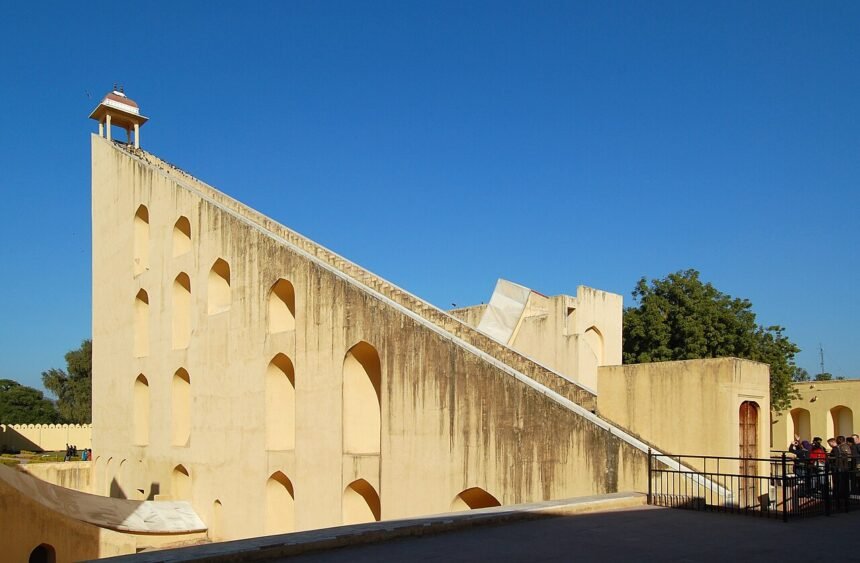
Tall triangular sundial structure and curved stone scales at Jantar Mantar in Jaipur.
The Samrat Yantra at Jaipur’s Jantar Mantar, photographed in January 2011. Image credit: Marcin Białek / Wikimedia Commons (CC BY-SA 3.0).

At Jantar Mantar in Jaipur, an instrument for telling time is large enough to look like a building. The Samrat Yantra has a tall triangular structure, with curved scales beside it. Sunlight and shadow make the instrument work. On a clear day, a visitor can watch the shadow move and see how a daily change in the Sun’s apparent position becomes something measurable on a marked surface.

Contents
What Jai Singh II built in JaipurWatch the shadow, then look for the scaleWhy the observatory needed more than one instrument

This is one reason the observatory belongs in the history of astrology as well as astronomy. A chart needs a set of positions and a time before anyone can interpret it. The observatory makes that first part of the process visible. Its stone and metal instruments show that obtaining a usable reading once meant deciding where to stand, aligning a structure and reading a scale carefully.

What Jai Singh II built in Jaipur

The UNESCO World Heritage listing dates Jaipur’s observatory to the early eighteenth century and describes roughly twenty major fixed instruments. It identifies Sawai Jai Singh II as the courtly patron behind the project and places the instruments within a wider tradition of positional astronomy. The nomination dossier explains how separate instruments and groups of instruments sit within one enclosure in the historic centre of Jaipur. Once you know that each structure has a job, the site becomes easier to read.

There is a practical reason to build a large fixed instrument. If two adjacent markings indicate a small change in angle or time, a longer scale gives the maker more room to space those markings apart. That can make a small difference easier to see. The reading still depends on how the instrument was aligned, how the marks were made and where the observer decides the shadow falls. Leave room for those limits when you hear a claim about a historical instrument’s precision.

Watch the shadow, then look for the scale

On a sundial, the part that casts the shadow is called a gnomon. At the Samrat Yantra, follow the edge of the shadow to the markings on the curved surface. When returning to the same spot later, look again before trying to work out the time. The change in position is the most direct thing to observe. It gives you a way to connect the geometry of the instrument to what the Sun appears to do in the sky.

A dial’s reading is also different from the number you see on a phone. The dial follows the apparent Sun at the site. A phone shows the civil time assigned to a time zone. The Sun and a clock can also drift relative to one another through the year. For a comparison to mean anything, you need to know which scale you are reading and how a local solar observation relates to the civil-time number you expect.

Why the observatory needed more than one instrument

The astronomy heritage study published by UNESCO and its partners describes instruments designed for several kinds of observations. The Ram Yantra, for example, uses a central pillar and a cylindrical form to help measure a celestial object’s height above the horizon. The Rashivalaya group was designed for readings related to zodiacal coordinates. A person trying to answer a question about a celestial position would choose the instrument suited to that question.

UNESCO also connects the site with royal authority and social practices linked to cosmology. Seen up close, those ideas have a material counterpart. Before anyone could draw on the sky for calendar-making or astrological interpretation, someone had to decide how to describe that sky and how to keep records that other observers could use. A short walk from the sundial to a positional instrument can show how different those tasks are. For an example of the way later traditions subdivide the sky, read The Popular Story’s guide to nakshatra padas.

Featured image: Marcin Białek / Wikimedia Commons (CC BY-SA 3.0). Image source.

Subscribe to Our Newsletter

Subscribe to our newsletter to get our newest articles instantly!

[mc4wp_form]

Sign Up For Daily Newsletter

Be keep up! Get the latest breaking news delivered straight to your inbox.
[mc4wp_form]
By signing up, you agree to our Terms of Use and acknowledge the data practices in our Privacy Policy. You may unsubscribe at any time.
Share This Article
Facebook Twitter Email Copy Link Print
By Mohit Patel
Follow:
Mohit Patel is an Indian entrepreneur, digital marketing professional, and Founder & CEO of MP Media Promotion. With expertise in public relations, media outreach and brand building, he helps businesses and personalities strengthen their visibility. He also founded The Popular Story, a magazine platform highlighting inspiring individuals and emerging talent across India.
Leave a comment Leave a comment

Leave a Reply Cancel reply

Your email address will not be published. Required fields are marked *

SUBSCRIBE NOW

Subscribe to our newsletter to get our newest articles instantly!

[mc4wp_form]

HOT NEWS

A movie camera on a tripod

IFFI’s Films About Films Section Turns the Camera on Cinema Itself

The International Film Festival of India has added a section devoted to films about the…

November 19, 2026
Technicians in white protective suits stand around the Roman Space Telescope in a clean room.

NASA Sets 7 December for the Roman Space Telescope’s First Images

NASA plans to unveil the first images from the Nancy Grace Roman Space Telescope on…

November 20, 2026
A bright exhaust plume pours from an engine mounted on the Fred Haise Test Stand.

NASA Fires an Artemis Development Engine for 200 Seconds in Mississippi

An RS-25 engine burned for three minutes and 20 seconds at NASA’s Stennis Space Center…

November 20, 2026

YOU MAY ALSO LIKE

What the Vedanga Jyotisha Was Trying to Calculate

Imagine planning a ceremony several months in advance when the timing depends on the Moon and on the season. A…

AstrologyTop News
November 20, 2026

How Curling Scores an End and Why the Hammer Matters

A curling team can have three stones inside the target and still score nothing. The value of those stones depends…

SportsTop News
November 20, 2026

How to Follow a Squash Match Before the Sport’s LA28 Olympic Debut

In squash, both players face the same front wall and share the same small court. The ball can come back…

SportsTop News
November 20, 2026

Gukesh vs Sindarov: When to Watch the 2026 World Chess Championship in India

India’s D. Gukesh starts his first defence of the undisputed world chess title on 24 November 2026, when he plays…

SportsTop News
November 20, 2026
Copyright © 2025-2026 MP Media. All rights reserved.

About Us

The Popular Story is a digital magazine and news publication bringing you stories from entertainment, sports, lifestyle, astrology and the world, with a focus on clear, original and reliable reporting.

Quick Links

  • About The Popular Story
  • Privacy Policy
  • Terms and Conditions
  • Disclaimer
  • Editorial Policy
  • Corrections Policy
  • Our Team

Follow us on Social Media

Explore

  • Contact Us
  • Entertainment
  • Sports
  • Lifestyle

Latest Magazine

View Magazine
© 2026 The Popular Story. All rights reserved.Privacy
Welcome Back!

Sign in to your account

Lost your password?