The Popular Story
  • About Us
  • Articles
  • Success Stories
  • Contact Us
  • About UsArticlesSuccess StoriesContact Us
HomeTop NewsEntertainmentSportsLifestyleAstrologyWorld
Magazine
All IssuesIconic Personalities of the Year 2026July 2026 | The Business Visionaries EditionThe Popular Story 40 Under 40Top 50 Iconic Personalities of 2026
Lists
40 Under 40Top 50 Iconic PersonalitiesIconic Personalities of the Year
Connect+
InstagramFacebookXYouTubeLinkedIn
All Categories
HomeTop NewsEntertainmentSportsLifestyleAstrologyWorldMagazine40 Under 40Top 50 Iconic PersonalitiesIconic Personalities of the YearAbout Us
Font ResizerAa
The Popular StoryThe Popular Story
Search
Follow US
Copyright © 2025-2026 MP Media. All rights reserved.
The Popular Story > Lifestyle > How to Measure How Much Water Your Shower Uses
LifestyleTop News

How to Measure How Much Water Your Shower Uses

By Mohit Patel Last updated: November 20, 2026 5 Min Read
Share
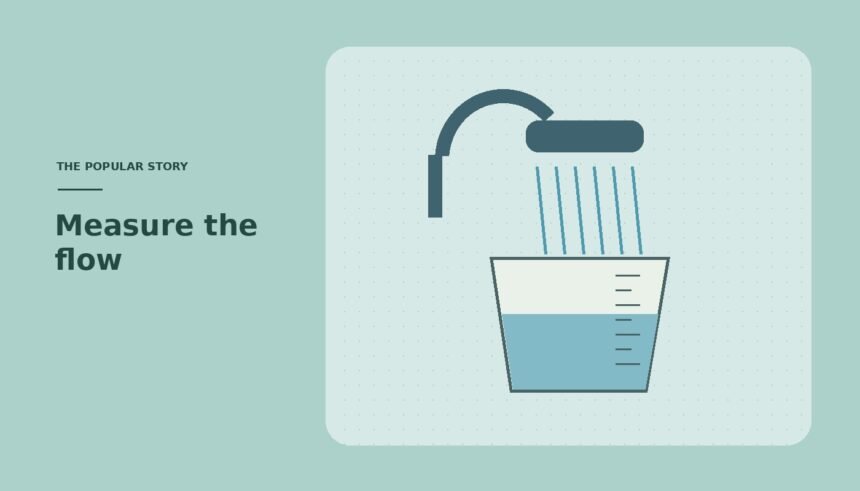
A shower spraying water into a marked measuring container.
An illustration of a shower spraying water into a marked measuring container. Image credit: Illustration by OpenAI for The Popular Story.

Shower water is hard to count while it is running down a drain. If you want to know whether a shorter shower or a change in the spray setting makes a difference, start with a simple measurement. A container with a known volume and a timer can give you a useful estimate. Measuring the shower you actually use is more informative than assuming it runs at the rate printed on a new fitting.

Contents
Measure one setting at a timeTranslate the result into a routine you recogniseCompare before and after on the same terms

The US Environmental Protection Agency discusses flow rates in its WaterSense guide to showerheads. Its home inspection guidance describes capturing the water in a container as one way to check flow. A home estimate can use the same principle. Keep the units simple and record which setting you used, so you will be able to repeat the test later.

Measure one setting at a time

Use a clean bucket or large measuring jug that can catch the spray without water spilling over the sides. Set the shower to the flow you usually use and keep the spray pattern consistent. If you have a handheld showerhead, direct it into a container that is standing securely. Avoid standing under hot water to get a measurement. A brief test at a comfortable temperature is enough to understand the method.

Collect water for an easily timed interval, such as 15 seconds, then note how much you caught. If you captured two litres in 15 seconds, multiply by four to estimate eight litres a minute. If the container filled early or the spray escaped around it, try again with a larger one. Use a container with readable markings, or pour into a measuring jug in stages and add the volumes together.

Repeat once to see whether the figures are reasonably close. If they differ, look at how you ran the test before averaging them. Someone using another tap at the same time can change the flow in some homes. A shower with different spray modes may also behave differently depending on which one you select. Measure the one you use most often and label any other test separately.

Translate the result into a routine you recognise

Eight litres a minute for five minutes gives an estimated 40 litres. The calculation describes time with the water running. It can overstate use if you normally stop the flow partway through. It can understate use if you leave the shower running before stepping in. Keep the estimate tied to your routine instead of assuming every person in the household uses the same amount.

Before making a purchase, see what difference you can get from a small change in the way you already shower. If you reduce running time by one minute and the flow remains eight litres a minute, the arithmetic gives a difference of about eight litres for that shower. If you change both the showerhead and the duration, measure again with the new fitting and compare the two estimates on the same basis.

Compare before and after on the same terms

Keep a note of the date, the spray setting, the volume collected and the collection time. If you observe a change in pressure at different times of day, test at the hour when people in your home usually shower. A single measurement is a snapshot. A pair of readings taken the same way can be more useful for comparing changes than a product label and a guess. For more home guides, explore The Popular Story’s Lifestyle section.

When you have finished, put the collected water to another appropriate use, such as cleaning the shower floor. You can use the same bucket for the comparison later, so the volume markings and the way you collect the spray stay consistent.

Featured image: Illustration by OpenAI for The Popular Story.

Subscribe to Our Newsletter

Subscribe to our newsletter to get our newest articles instantly!

[mc4wp_form]

Sign Up For Daily Newsletter

Be keep up! Get the latest breaking news delivered straight to your inbox.
[mc4wp_form]
By signing up, you agree to our Terms of Use and acknowledge the data practices in our Privacy Policy. You may unsubscribe at any time.
Share This Article
Facebook Twitter Email Copy Link Print
By Mohit Patel
Follow:
Mohit Patel is an Indian entrepreneur, digital marketing professional, and Founder & CEO of MP Media Promotion. With expertise in public relations, media outreach and brand building, he helps businesses and personalities strengthen their visibility. He also founded The Popular Story, a magazine platform highlighting inspiring individuals and emerging talent across India.
Leave a comment Leave a comment

Leave a Reply Cancel reply

Your email address will not be published. Required fields are marked *

SUBSCRIBE NOW

Subscribe to our newsletter to get our newest articles instantly!

[mc4wp_form]

HOT NEWS

A movie camera on a tripod

IFFI’s Films About Films Section Turns the Camera on Cinema Itself

The International Film Festival of India has added a section devoted to films about the…

November 19, 2026
Technicians in white protective suits stand around the Roman Space Telescope in a clean room.

NASA Sets 7 December for the Roman Space Telescope’s First Images

NASA plans to unveil the first images from the Nancy Grace Roman Space Telescope on…

November 20, 2026
A bright exhaust plume pours from an engine mounted on the Fred Haise Test Stand.

NASA Fires an Artemis Development Engine for 200 Seconds in Mississippi

An RS-25 engine burned for three minutes and 20 seconds at NASA’s Stennis Space Center…

November 20, 2026

YOU MAY ALSO LIKE

Why the Doorways in Nosferatu Still Make Us Uneasy

One of the starkest images in F.W. Murnau’s Nosferatu is a man standing inside a doorway. Count Orlok is upright…

EntertainmentTop News
November 20, 2026

How to Spend an Hour in a Museum Without Rushing Through It

Museums make it easy to feel behind before you have seen anything. There may be three floors, a temporary exhibition…

LifestyleTop News
November 20, 2026

How to Prepare Offline Maps Before a Trip With Patchy Mobile Data

A hotel address can be familiar when you are looking at it at home and surprisingly hard to find when…

LifestyleTop News
November 20, 2026

How Sherlock Jr. Turns a Film Cut Into a Joke

A projectionist falls asleep at work, walks towards the screen and discovers that a movie has its own rules of…

EntertainmentTop News
November 20, 2026
Copyright © 2025-2026 MP Media. All rights reserved.

About Us

The Popular Story is a digital magazine and news publication bringing you stories from entertainment, sports, lifestyle, astrology and the world, with a focus on clear, original and reliable reporting.

Quick Links

  • About The Popular Story
  • Privacy Policy
  • Terms and Conditions
  • Disclaimer
  • Editorial Policy
  • Corrections Policy
  • Our Team

Follow us on Social Media

Explore

  • Contact Us
  • Entertainment
  • Sports
  • Lifestyle

Latest Magazine

View Magazine
© 2026 The Popular Story. All rights reserved.Privacy
Welcome Back!

Sign in to your account

Lost your password?