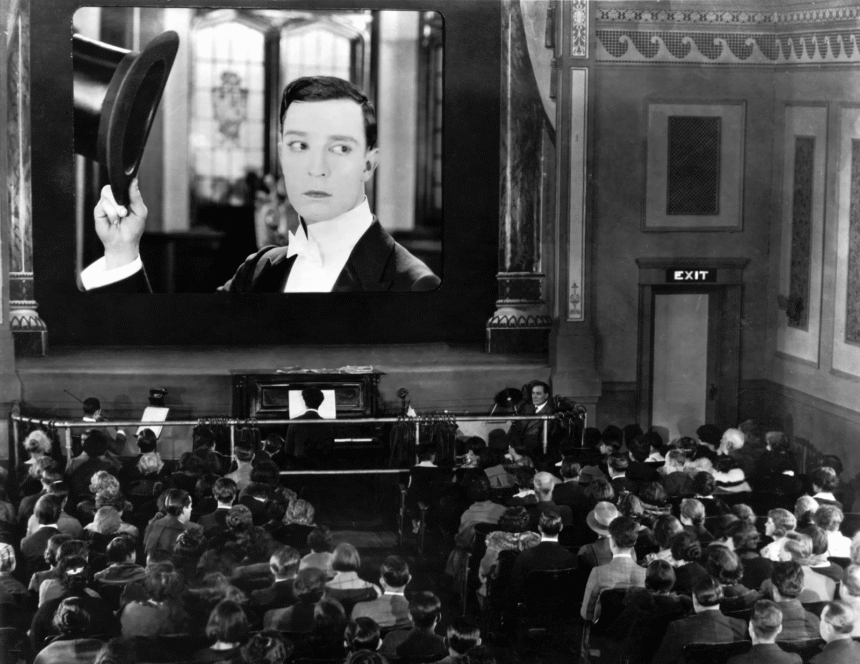
A projectionist falls asleep at work, walks towards the screen and discovers that a movie has its own rules of space. In Buster Keaton’s Sherlock Jr., released in 1924, the man’s surroundings can change between one step and the next. He is still standing in roughly the same spot in the frame. The place around him has gone somewhere else. That difference between the actor’s steady position and the image’s abrupt changes is the engine of one of silent comedy’s most resourceful sequences.
The surviving film is worth watching twice, once for the surprise and once to see how little of the work Keaton leaves to chance. Jeffrey Vance’s essay for the Library of Congress sets the sequence in the context of Keaton’s stage training and describes the film’s technically demanding effects.
The joke depends on recognising space
In ordinary editing, a cut can take us across a street or ahead in time. We expect a change in the picture to tell us that we have moved. Here the character carries over into the next view as though nothing has happened to his body. A sitting motion begun in one place threatens to end somewhere that offers nowhere to sit. The cut makes a promise about the next instant, and the new setting breaks it.
Choose one transition and watch Keaton’s outline. His size on the screen and the placement of his feet do much of the explanatory work. If he abruptly shifted to the other side of the image as well, an audience might read the change as a different shot of a person elsewhere. Holding the position gives the eye a fixed point. The background can then change around him without losing our sense of whose problem we are watching.
Why his face stays quiet
Keaton’s restrained reaction gives viewers time to discover each hazard for themselves. A large expression before a cut would tell us that a surprise was coming. An exaggerated response afterwards would pull attention towards the reaction just as the unfamiliar space needs to register. Instead he often seems to be catching up with the audience. We read the picture, see what his movement now means, and then watch him address the problem with the limited time available.
This is where projection matters to the story. The character knows films well enough to operate the equipment, and he wants to be a detective. Inside the dream, he gets a chance to inhabit the role he admires. Before that can happen, he has to negotiate a medium that can take him from a safe position to a dangerous one without moving him through the intervening distance. It is an economical way to make the job, the ambition and the joke part of the same scene.
What to watch after the dream
The film later gives Keaton room for chases, tricks and feats of timing. Try looking for the same rule at work. Is the joke something the camera reveals late, or does it come from watching a whole action play out within a shot? Those two kinds of pleasure feel different. The first makes an ordinary action newly legible. The second lets the viewer notice a hazard and anticipate the collision between a moving body and an object already in the frame.
Keaton can get a laugh from either method because he gives the viewer enough information to understand the action. That remains apparent even when prints differ in speed or accompaniment. For another look at the way cinema takes itself as a subject, see The Popular Story’s coverage of IFFI’s Films About Films programme.
The scene also makes a game of looking. The next change can happen anywhere around Keaton, so keeping him in view means staying alert to the rest of the picture.
Featured image: 1924 publicity still, photographer unknown, via Wikimedia Commons. Image source. Reuse terms.