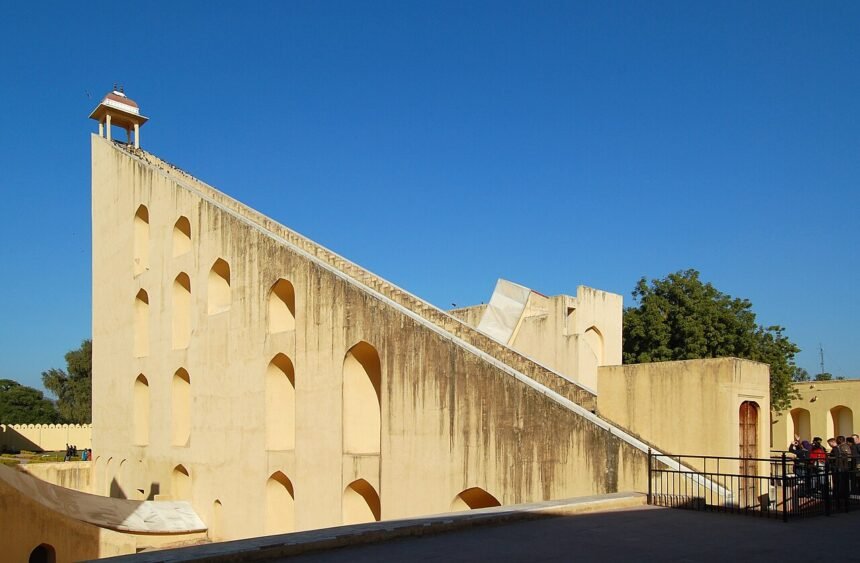
At Jantar Mantar in Jaipur, an instrument for telling time is large enough to look like a building. The Samrat Yantra has a tall triangular structure, with curved scales beside it. Sunlight and shadow make the instrument work. On a clear day, a visitor can watch the shadow move and see how a daily change in the Sun’s apparent position becomes something measurable on a marked surface.
This is one reason the observatory belongs in the history of astrology as well as astronomy. A chart needs a set of positions and a time before anyone can interpret it. The observatory makes that first part of the process visible. Its stone and metal instruments show that obtaining a usable reading once meant deciding where to stand, aligning a structure and reading a scale carefully.
What Jai Singh II built in Jaipur
The UNESCO World Heritage listing dates Jaipur’s observatory to the early eighteenth century and describes roughly twenty major fixed instruments. It identifies Sawai Jai Singh II as the courtly patron behind the project and places the instruments within a wider tradition of positional astronomy. The nomination dossier explains how separate instruments and groups of instruments sit within one enclosure in the historic centre of Jaipur. Once you know that each structure has a job, the site becomes easier to read.
There is a practical reason to build a large fixed instrument. If two adjacent markings indicate a small change in angle or time, a longer scale gives the maker more room to space those markings apart. That can make a small difference easier to see. The reading still depends on how the instrument was aligned, how the marks were made and where the observer decides the shadow falls. Leave room for those limits when you hear a claim about a historical instrument’s precision.
Watch the shadow, then look for the scale
On a sundial, the part that casts the shadow is called a gnomon. At the Samrat Yantra, follow the edge of the shadow to the markings on the curved surface. When returning to the same spot later, look again before trying to work out the time. The change in position is the most direct thing to observe. It gives you a way to connect the geometry of the instrument to what the Sun appears to do in the sky.
A dial’s reading is also different from the number you see on a phone. The dial follows the apparent Sun at the site. A phone shows the civil time assigned to a time zone. The Sun and a clock can also drift relative to one another through the year. For a comparison to mean anything, you need to know which scale you are reading and how a local solar observation relates to the civil-time number you expect.
Why the observatory needed more than one instrument
The astronomy heritage study published by UNESCO and its partners describes instruments designed for several kinds of observations. The Ram Yantra, for example, uses a central pillar and a cylindrical form to help measure a celestial object’s height above the horizon. The Rashivalaya group was designed for readings related to zodiacal coordinates. A person trying to answer a question about a celestial position would choose the instrument suited to that question.
UNESCO also connects the site with royal authority and social practices linked to cosmology. Seen up close, those ideas have a material counterpart. Before anyone could draw on the sky for calendar-making or astrological interpretation, someone had to decide how to describe that sky and how to keep records that other observers could use. A short walk from the sundial to a positional instrument can show how different those tasks are. For an example of the way later traditions subdivide the sky, read The Popular Story’s guide to nakshatra padas.
Featured image: Marcin Białek / Wikimedia Commons (CC BY-SA 3.0). Image source.