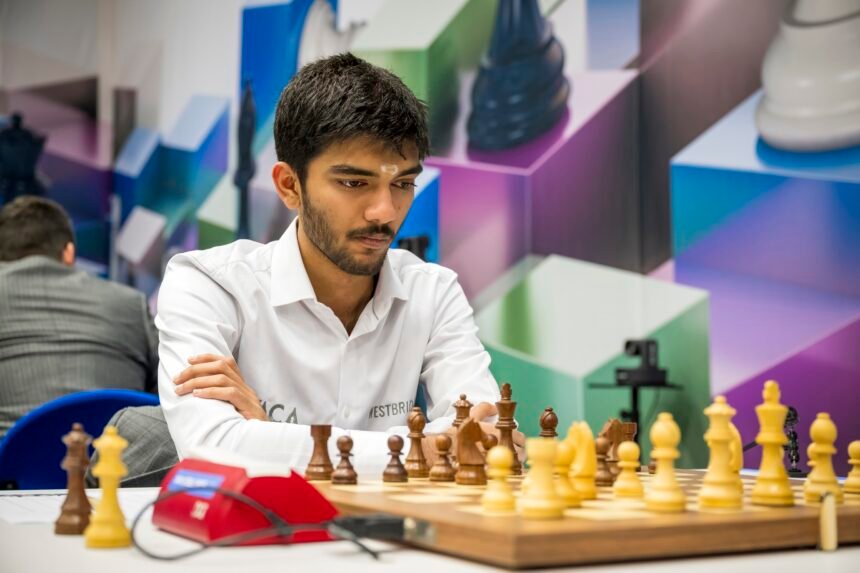
India’s D. Gukesh starts his first defence of the undisputed world chess title on 24 November 2026, when he plays Uzbekistan’s Javokhir Sindarov in the first classical game in Switzerland. The official match schedule lists a 3 p.m. start in Geneva, which is 7:30 p.m. IST. The programme opens on 22 November with a media day and ceremony. The opening ceremony and the first game fall on different days, so save the 24 November date if your main interest is the chess.
The match takes place at the Fondation Martin Bodmer in Cologny, according to the event’s venue guide. Both players are 20. Gukesh won the title against Ding Liren in Singapore in 2024. Sindarov qualified by winning the 2026 Candidates Tournament and came into that competition as the 2025 FIDE World Cup winner. The official programme extends to 12 December, when a tie-break is scheduled if the classical games leave the players level.
How the score works
Under the published match format, a win gives a player one point and a draw gives each player half a point. Fourteen classical games are on the schedule. The match ends as soon as either player reaches 7½ points. If both have seven after all fourteen games, they play a tie-break at faster time controls.
The practical effect is easy to see with an example. Suppose Gukesh leads 6–5 after eleven games. A draw in the twelfth would make the score 6½–5½. Gukesh would still need one point. A win in the thirteenth would take him to 7½, while another draw would leave the championship open for the fourteenth. The same arithmetic applies if Sindarov takes the lead. The example is hypothetical and shows why a quiet-looking draw can matter late in the match.
What to watch once the broadcast starts
Pay attention to the clocks as well as the board. A player who spends time early may be trying to choose between two playable plans. Later, a similar pause can carry much greater cost if several moves remain before the next time control. A broadcast that displays both clocks lets you see who has to make a consequential decision under more time pressure.
Pick one piece or one square to follow if the analysis moves quickly. A knight may spend several moves heading for a square where a pawn cannot chase it away. A rook may stay on a file because moving it would let the opponent enter. Those small decisions can make a strategic game easier to follow without keeping every possible variation in your head. After a game, replay the moment when the position changed and see whether the change followed an exchange, a pawn move or a clock shortage.
Which dates to save
The championship schedule groups most classical rounds into sets of three, with free days between them. Game one is on 24 November, games two and three follow on 25 and 26 November, and 27 November is a free day. The fourteenth classical game is listed for 11 December if the title still needs to be decided. The organisers list classical rounds at 7:30 p.m. IST after conversion from Central European Time. Consult the official schedule again before watching a possible tie-break as its time is listed separately.
For a viewer returning to chess after the team competition in Samarkand, the format is a useful point of difference in how the score is read. The Popular Story’s Chess Olympiad guide explains how the team score worked there. In Geneva, every half-point belongs directly to the title match between Gukesh and Sindarov.
Featured image: Frans Peeters. Image source. Reuse terms.