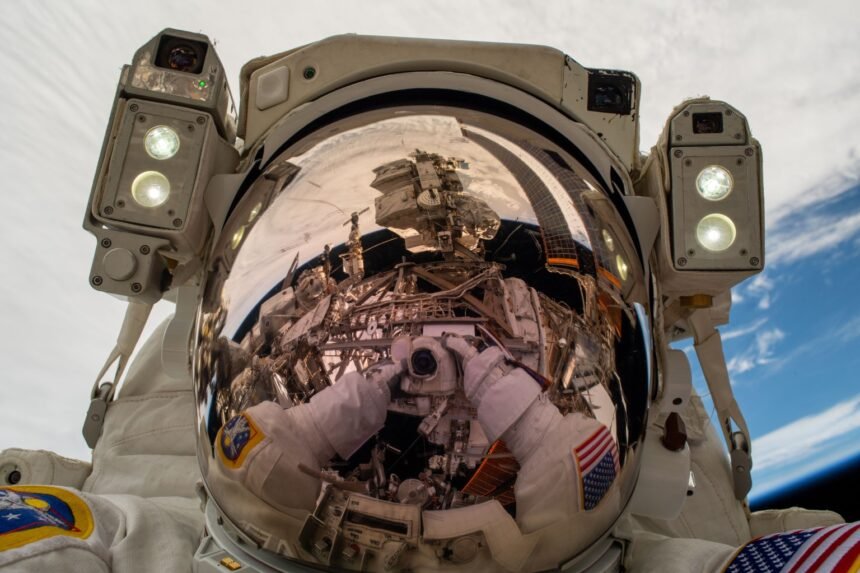
NASA published a photograph on 17 November 2026 that shows astronaut Anil Menon’s view from outside the International Space Station. Menon took the self-portrait during a 29 October spacewalk with Joshua Kutryk of the Canadian Space Agency. On that outing, the pair installed the seventh of eight roll-out solar arrays for a programme that had been under way since February 2021. They went outside again on 5 November to install the last one.
It helps to keep all three dates in view. The photograph comes from the October excursion. The final piece of the upgrade went into place in November. NASA released the photograph later as a look back. The gap between taking a photograph and publishing it is easy to miss when it appears next to current station news, but the original caption tells readers which outing they are seeing.
How the work was divided
The two spacewalks took place on opposite sides of the station’s truss, the long framework that carries the solar arrays. In its report on 29 October, NASA said the crew installed its seventh array on an electrical power channel called 2A. Menon and Kutryk also completed preparatory work for the next outing. An electrical channel is a useful detail because two astronauts can wear similar suits, work on similar equipment and still be operating on different parts of the station.
The 5 November report puts the last installation on channel 3B. NASA recorded the October spacewalk at seven hours and 11 minutes and the November outing at six hours and 59 minutes. The durations cover the full excursions. A short video of an array opening records only one part of a shift that also included moving through the worksite and getting the equipment into place.
Why the arrays roll out
A solar array needs a wide area exposed to sunlight. A launch vehicle has a limited amount of room to carry equipment. An array that travels in a compact form and opens after installation lets engineers work with both requirements. It also means that the shape seen during transport can be quite different from the shape that produces power in orbit. In material accompanying the November report, NASA showed a newly installed array unfolding on the station.
The extra generating capacity is a number worth putting in context. NASA estimates that the eight arrays together increase the station’s generating capacity from 160 kilowatts to approximately 215 kilowatts. That is the combined change for the programme. The last two installations completed the work, but the capacity increase reflects all eight arrays. NASA says astronauts made 18 spacewalks to prepare the electrical equipment and install them.
What the photograph adds
A picture made near the worksite gives the viewer a sense of what an astronaut was wearing and what the surrounding station looked like. The agency’s work reports provide the information a still photograph cannot convey on its own, such as the electrical channel and what was completed on each day. The pieces of evidence work together. One puts a person in the setting. The other gives a dated record of the job.
If you see a photograph of Menon and Kutryk beside a report about the final array, check the caption for the original date. NASA published photographs and coverage from both outings, and each records its own step in the same project. The agency’s spacewalk log lists both entries. For more international reporting, see The Popular Story’s World coverage.
The station’s upgrade took years because crew schedules had to account for separate jobs outside the airlock. Installing the last array closed the power programme described in NASA’s report. Station upkeep continues, and later spacewalks will have their own objectives, crews and dates.