Delhi’s government has announced fresh steps to limit air pollution before the winter peak, with a ban on open burning of rubbish and an order for food stalls to stop using coal or firewood, according to an AFP report published on 23 October 2026. On 5 November the BBC asked in a headline whether the capital is prepared as its toxic winter air returns.
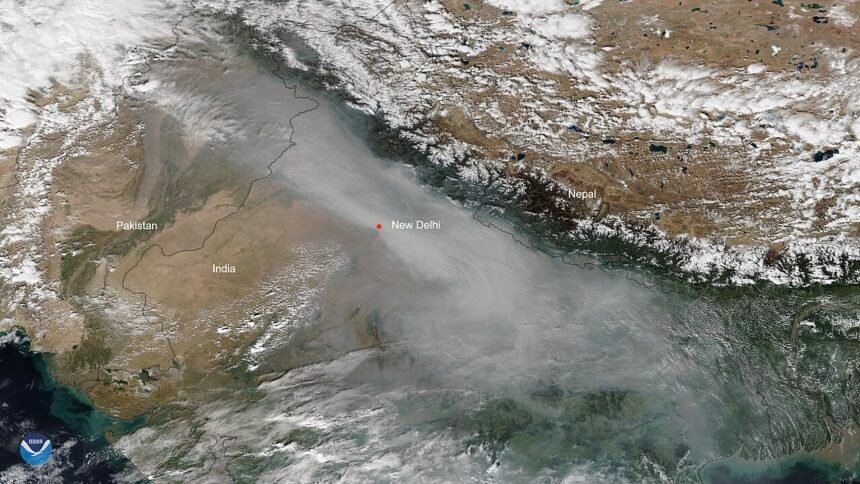
Photo credit: NOAA (public domain, via Wikimedia Commons). File image of smog over Delhi and northern India from 2019.
What has been announced
- A ban on burning rubbish in the open.
- An order for food stalls to stop using coal or firewood for cooking.
What the numbers show
Delhi has around 30 million residents, and pollution there usually peaks between November and January. AFP reports that PM2.5 levels often cross 300 micrograms per cubic metre, about 20 times the World Health Organization’s recommended daily maximum. Monitors recorded 233 early on a Thursday in October, roughly 15 times that limit. Last year’s peak was 846, or 56 times the limit.
Where the pollution comes from
The report names coal-fired power plants, traffic, construction and the burning of crop stubble in nearby areas as the main sources. The Commission for Air Quality Management has said air quality is likely to stay in the “poor” category in the coming days.
Why it matters for health
A 2024 study in The Lancet Planetary Health estimated that 3.8 million deaths in India between 2009 and 2019 were linked to pollution above the country’s own guidelines. UNICEF warns that polluted air raises the risk of acute respiratory infections in children.
What we could not confirm
We could not independently confirm today’s air quality readings or any measures announced after 23 October. Readers should check the official CPCB and CAQM bulletins for the latest figures.
Sources: AFP report published by The Star (23 October 2026); BBC headline of 5 November 2026. Written by The Popular Story desk from published reports.