
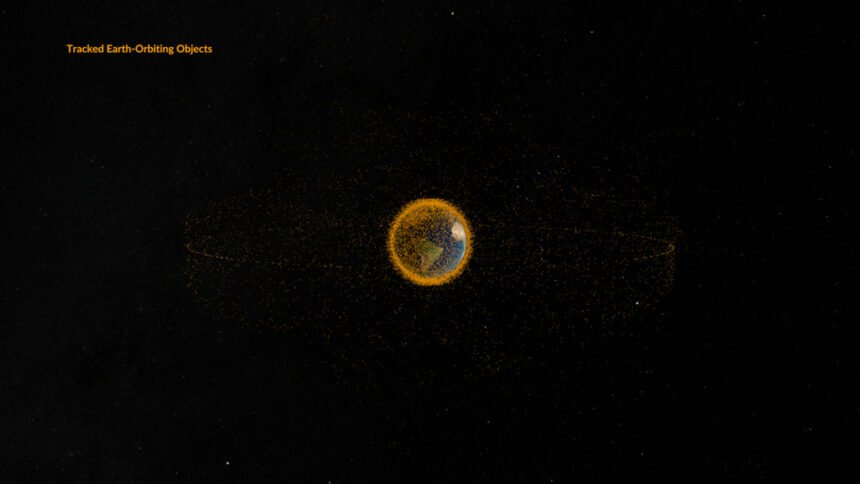
India has set itself a deadline for keeping its space missions free of orbital debris. According to the Indian Space Research Organisation (ISRO), the Debris Free Space Missions (DFSM) initiative aims for zero-debris missions from all Indian space actors, government and private, by 2030. A 6 November NDTV headline described the plan as “Swachh Space”.
Photo credit: NASA Scientific Visualization Studio (public domain, via Wikimedia Commons). The image shows tracked satellites and debris in Earth orbit.
When and where it was announced
ISRO Chairman S. Somanath announced the goal on 16 April 2024 at the opening plenary of the 42nd annual meeting of the Inter-Agency Space Debris Coordination Committee (IADC) in Bengaluru. ISRO says implementation began at the mission planning and design level from the start of 2025.
What the guidelines require
- Preventing debris from being created during satellite and launch-vehicle operations and during disposal after a mission.
- Preventing collisions and break-ups in orbit through failure studies, backup systems and reliable mission design.
- Avoiding deliberate break-ups that leave long-lived debris.
- Disposing of rocket bodies and spacecraft after their mission with a success probability above 99 per cent, either by controlled re-entry or by moving them to a lower orbit where they will remain for less than five years.
Other commitments for 2030
ISRO also lists planning missions with human spaceflight safety in mind, making sure satellites can be tracked, identified and manoeuvred, extending a mission only after checking the spacecraft is healthy enough to be disposed of safely, and sharing data nationally and internationally. For human missions it identifies an orbital band of 400 km, give or take 30 km, and says missions should avoid minimum orbital transfers within it.
How it will be carried out
Missions are to choose orbital slots with collision threats in mind, budget fuel for disposal and plan trajectories that include controlled re-entry or de-orbiting. Progress is to be reviewed every year. ISRO’s System for Safe and Sustainable Space Operations Management (IS4OM) is the nodal point, supported by other Department of Space units.
What we could not confirm
The ISRO page we reviewed describes the announcement and the planned start of implementation but does not list completed actions, so we cannot say how much progress has been made so far.
Sources: ISRO, “India’s Intent on Debris-Free Space Missions – Explained” (isro.gov.in); NDTV headline of 6 November 2026. Written by The Popular Story desk from published material.