Iran’s Revolutionary Guard said on Friday, 13 November, that a gas tanker hit a naval mine and exploded in the eastern Strait of Hormuz. Hours earlier, the same force claimed it had destroyed a US early-warning radar in Bahrain. Neither claim has been independently confirmed, but together they mark a sharp new turn in a sea war that has now run for more than eight months.
The Islamic Revolutionary Guard Corps (IRGC) navy said the ship was using a southern route it called “unauthorized and dangerous” and had ignored repeated warnings. It did not name the vessel, its flag or its crew. Iranian media released images of a large blast and fire. Reports differed on whether the cargo was liquefied natural gas (LNG) or liquefied petroleum gas (LPG).
What Iran is claiming
According to Iran’s IRNA news agency, quoted by the Associated Press, the radar attack was retaliation for a US strike on a telecommunications tower in the southern port of Sirik. The Guard described it as “a serious warning to the US to cease its strikes.” It is the first reported Iranian strike on a facility in Bahrain since September.
Bahrain hosts the headquarters of the US Navy’s Fifth Fleet, which makes any attack there highly sensitive. Neither Washington nor Manama had confirmed any damage at the time of writing.
The IRGC also warned that any ship breaking its rules for the strait “will meet the fate of previous vessels.” It said the gas carrier had chosen to sail under the cover of American jets, a claim no US or Western military source backed.
A strait under siege
The incident comes after a bruising few weeks at sea. Iranian media said four oil tankers were hit by explosions on Thursday, a day after two supertankers were reported ablaze. The Washington Institute for Near East Policy counted at least 10 ship strikes in the first 10 days of November, after 37 attacks in October. That was the highest monthly total since the conflict began on 28 February.
The waterway has been shut and reopened several times this year. Here is the broad timeline, based on Iranian, US and maritime reports:
- 28 February: the US-Iran conflict begins.
- April: the US imposes a naval blockade and Iran closes the strait.
- June to July: a reopening deal collapses, Iran closes the strait again and the US reinstates its blockade.
- 26 October: the IRGC declares Hormuz closed once more.
The US military says it has cleared the main mine-free channels, escorts tankers and keeps a blockade on Iranian ports. Iran’s campaign appears designed to keep the risk high for all shipping rather than to target specific ships, said Noam Raydan of the Washington Institute, as cited by regional outlets.
Why a gas carrier matters
Earlier attacks on gas carriers this year used drones or projectiles, not mines. LNG ships carry super-cooled fuel in giant insulated tanks, and analysts say they face higher risks than crude tankers if hit. Reuters has noted that no commercial LNG carrier has ever suffered a catastrophic cargo-tank explosion at sea, which is one reason observers are treating Iran’s claim with caution.
Roughly a fifth of the world’s LNG normally passes through Hormuz each year. Estimates cited by analysts suggest Qatar’s LNG shipments through the strait have fallen by about 96% compared with last year. Asian spot LNG prices climbed above $30 per million British thermal units in late October, their highest level since December 2022. Brent crude traded around $92 to $96 a barrel on 12-13 November, even as hopes of de-escalation had pulled prices off their highs.
What it means for India
For India, the stakes are direct. India imports most of its crude, and Qatar is among its biggest LNG suppliers. A large share of both normally comes through the Strait of Hormuz. Higher freight and insurance costs feed into fuel, fertiliser and power prices at home, and Indian seafarers make up a big part of the crews on Gulf shipping routes.
Diplomacy offers little comfort for now. US President Donald Trump told radio host Hugh Hewitt this week that he would not hesitate to strike Iran again, and claimed the US “totally” controls the strait. Iran, for its part, has said it could reopen the waterway quickly if a list of conditions is met, while calling the latest US response “not convincing.”
Separately, the UN nuclear watchdog said it is “increasingly concerned” about an enrichment plant at Isfahan that Iran has declared but not opened to inspectors. With shipping attacks running at record levels and talks stalled, traders and governments will be watching the strait closely in the days ahead.
Reporting based on Associated Press via The Pioneer, Türkiye Today and The Times of Israel.
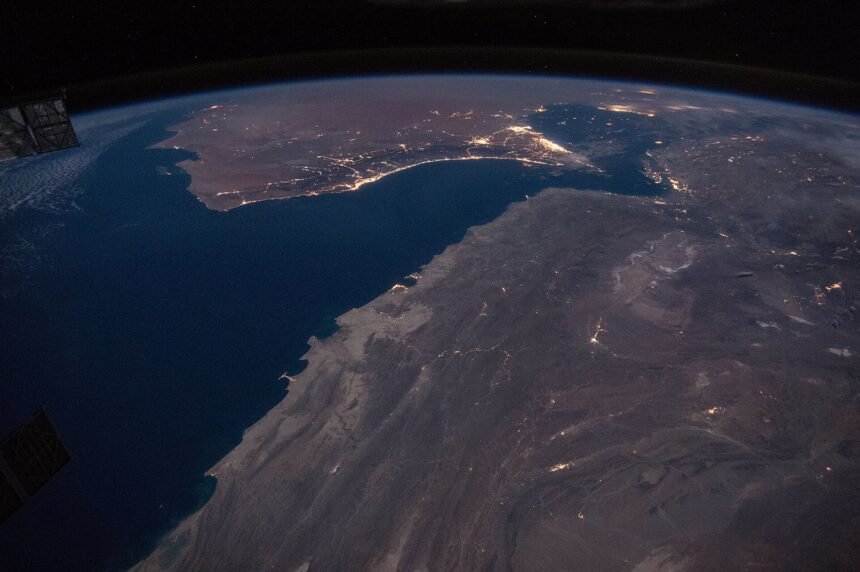
Featured image: NASA/Tim Kopra, via Wikimedia Commons (Public domain)