The Popular Story
  • About Us
  • Articles
  • Success Stories
  • Contact Us
  • About UsArticlesSuccess StoriesContact Us
HomeTop NewsEntertainmentSportsLifestyleAstrologyWorld
Magazine
All IssuesIconic Personalities of the Year 2026July 2026 | The Business Visionaries EditionThe Popular Story 40 Under 40Top 50 Iconic Personalities of 2026
Lists
40 Under 40Top 50 Iconic PersonalitiesIconic Personalities of the Year
Connect+
InstagramFacebookXYouTubeLinkedIn
All Categories
HomeTop NewsEntertainmentSportsLifestyleAstrologyWorldMagazine40 Under 40Top 50 Iconic PersonalitiesIconic Personalities of the YearAbout Us
Font ResizerAa
The Popular StoryThe Popular Story
Search
Follow US
Copyright © 2025-2026 MP Media. All rights reserved.
The Popular Story > Top News > NASA Fires an Artemis Development Engine for 200 Seconds in Mississippi
Top NewsWorld

NASA Fires an Artemis Development Engine for 200 Seconds in Mississippi

By Mohit Patel Last updated: November 20, 2026 5 Min Read
Share
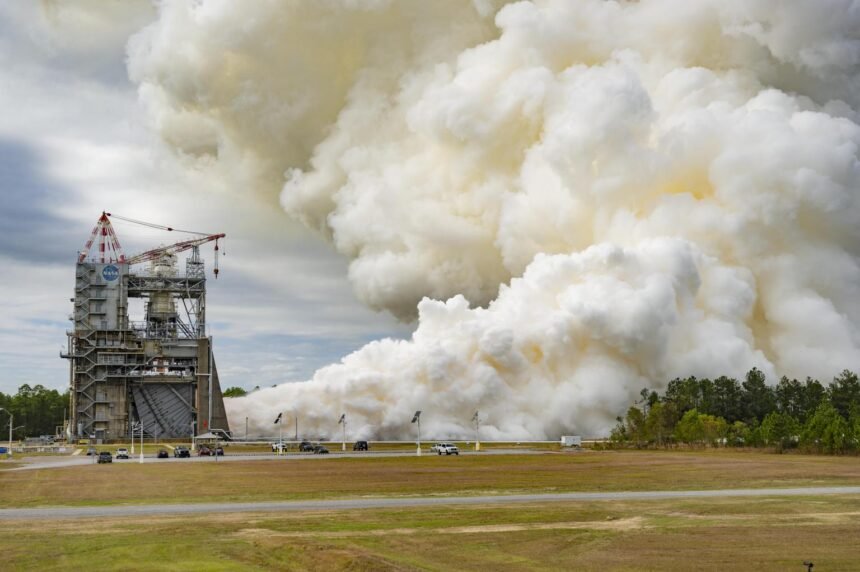
A bright exhaust plume pours from an engine mounted on the Fred Haise Test Stand.
NASA fires RS-25 developmental engine 10001 at Stennis Space Center, Mississippi, on 18 November 2026. Photo: NASA/Danny Nowlin.

An RS-25 engine burned for three minutes and 20 seconds at NASA’s Stennis Space Center in Mississippi on 18 November 2026. The test ended at its planned 200-second mark, according to NASA’s account. The engine, numbered 10001, was bolted into the Fred Haise Test Stand. It will stay on the ground. The point of running it was to collect evidence that NASA and engine contractor L3Harris Technologies can use on hardware intended for future Artemis missions.

Contents
Why the same test engine keeps firingWhat a test stand lets engineers seeHow the engine fits into Artemis

That distinction matters when reading an announcement about a rocket engine. There is a difference between running a development article and clearing a particular flight engine for a particular launch. A development article gives engineers a chance to observe how a design behaves under selected conditions. A flight engine is an individual piece of hardware that has to be checked before it can be installed on a rocket. The November firing belonged to the development side of that work.

Why the same test engine keeps firing

Engine 10001 had already completed a longer run at Stennis on 21 October 2026. In its report on that firing, NASA said the engine ran for 500 seconds, roughly as long as the RS-25 engines fire during a Space Launch System launch. NASA also reported that the earlier test ran at the 111 percent power level. That is a value on the engine’s rating scale. It tells readers how NASA describes the operating condition, rather than giving a percentage of how much fuel was used.

The agency’s account of the November test gives its duration and purpose. It does not give the same level of detail about the engine’s operating conditions. A shorter firing can give engineers the observations they need for a different part of a programme. Without the test plan, the change in length alone says very little. Watch for an agency report that identifies a specific change in hardware, an operating condition or a result engineers can compare against an earlier test.

What a test stand lets engineers see

A launch vehicle has to leave the ground, steer and fly through changing conditions. Fixing an engine to a stand gives a test team a way to study it while keeping it in a known place. The crew can check measurements around the firing and inspect components after shutdown. As with a car taken to a workshop after a test drive, some useful evidence comes from what people find after the noise stops.

A photograph captures the fire and exhaust. It cannot show how a part wore, whether a sensor stayed within expectations or what the operator saw in the control room. Those details can matter more to the next test decision than the visual drama. A picture of a real firing is good documentary evidence of what took place at the stand. The engineering conclusions come from the measurements and inspections.

How the engine fits into Artemis

NASA’s Space Launch System uses four RS-25 engines. The agency says they can produce up to two million pounds of combined thrust. They are part of the rocket NASA plans to use to send astronauts aboard Orion on Artemis IV. In its 19 November announcement, NASA described that mission as a lunar landing planned for 2028, with a launch from Kennedy Space Center in Florida.

The November test gives readers a specific event to follow between launches. When a later firing is announced, compare the engine number, the duration and the stated purpose before drawing a connection. The same number usually points back to the same piece of test hardware. For more on international science and policy, browse The Popular Story’s World coverage.

There is one more useful detail in the announcement itself. NASA dated the photograph and firing to 18 November, while the report appeared the following day. Keeping those two dates straight makes it easier to follow updates from Stennis, particularly when the same engine appears in several images taken weeks apart.


Subscribe to Our Newsletter

Subscribe to our newsletter to get our newest articles instantly!

[mc4wp_form]

Sign Up For Daily Newsletter

Be keep up! Get the latest breaking news delivered straight to your inbox.
[mc4wp_form]
By signing up, you agree to our Terms of Use and acknowledge the data practices in our Privacy Policy. You may unsubscribe at any time.
Share This Article
Facebook Twitter Email Copy Link Print
By Mohit Patel
Follow:
Mohit Patel is an Indian entrepreneur, digital marketing professional, and Founder & CEO of MP Media Promotion. With expertise in public relations, media outreach and brand building, he helps businesses and personalities strengthen their visibility. He also founded The Popular Story, a magazine platform highlighting inspiring individuals and emerging talent across India.
1 Comment 1 Comment
  • Pingback: NASA Roman Telescope First Images: Date and India Time

Leave a Reply Cancel reply

Your email address will not be published. Required fields are marked *

SUBSCRIBE NOW

Subscribe to our newsletter to get our newest articles instantly!

[mc4wp_form]

HOT NEWS

A movie camera on a tripod

IFFI’s Films About Films Section Turns the Camera on Cinema Itself

The International Film Festival of India has added a section devoted to films about the…

November 19, 2026
Illustration of NASA's Voyager spacecraft with its large dish antenna

Voyager 1 Reaches One Light-Day From Earth on 18 November, 49 Years After Launch

NASA's Voyager 1 will be one light-day from Earth at 10:16 UTC on 18 November…

November 17, 2026
Technicians in white protective suits stand around the Roman Space Telescope in a clean room.

NASA Sets 7 December for the Roman Space Telescope’s First Images

NASA plans to unveil the first images from the Nancy Grace Roman Space Telescope on…

November 20, 2026

YOU MAY ALSO LIKE

NASA Sets 7 December for the Roman Space Telescope’s First Images

NASA plans to unveil the first images from the Nancy Grace Roman Space Telescope on 7 December 2026. The agency’s…

Top NewsWorld
November 20, 2026

Why the Empire State Building Went Gold for Voyager 1

New York’s Empire State Building shone gold on the evening of 17 November 2026. The light marked an occasion well…

Top NewsWorld
November 20, 2026

Anil Menon’s Spacewalk Photo Records a Step in the ISS Power Upgrade

NASA published a photograph on 17 November 2026 that shows astronaut Anil Menon’s view from outside the International Space Station.…

Top NewsWorld
November 20, 2026

Small Businesses Take Over Hall 6 at the India International Trade Fair

A pavilion for small businesses and traditional producers opened in Hall 6 at New Delhi’s Bharat Mandapam on 18 November…

NewsTop News
November 20, 2026
Copyright © 2025-2026 MP Media. All rights reserved.

About Us

The Popular Story is a digital magazine and news publication bringing you stories from entertainment, sports, lifestyle, astrology and the world, with a focus on clear, original and reliable reporting.

Quick Links

  • About The Popular Story
  • Privacy Policy
  • Terms and Conditions
  • Disclaimer
  • Editorial Policy
  • Corrections Policy
  • Our Team

Follow us on Social Media

Explore

  • Contact Us
  • Entertainment
  • Sports
  • Lifestyle

Latest Magazine

View Magazine
© 2026 The Popular Story. All rights reserved.Privacy
Welcome Back!

Sign in to your account

Lost your password?