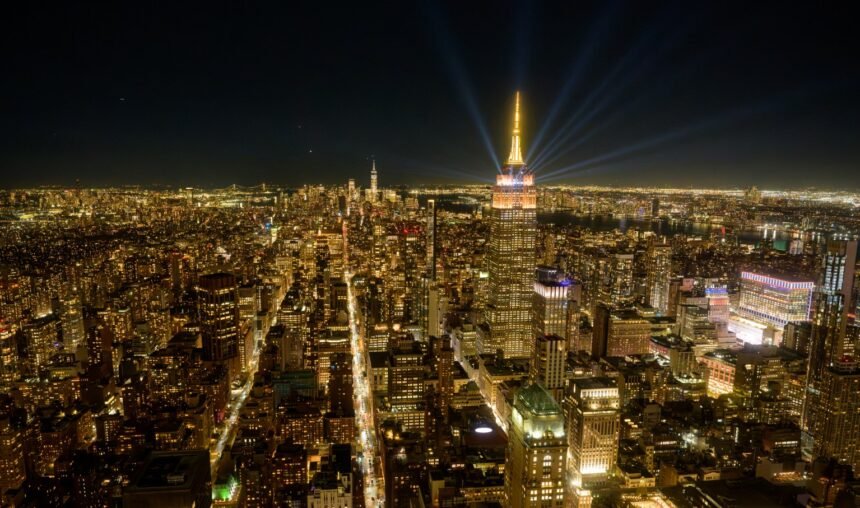
New York’s Empire State Building shone gold on the evening of 17 November 2026. The light marked an occasion well outside the city, and well outside the region shaped by the solar wind. NASA was preparing to confirm that Voyager 1 had become the first human-made object one light-day from Earth. The agency’s photograph of the illumination shows the upper part of the building lit above its neighbours. NASA said the colour recalled the gold-plated record attached to the probe.
The spacecraft itself crossed the threshold on 18 November. In its confirmation the following day, NASA placed the crossing at 2:16 a.m. Pacific Standard Time on 18 November, or 3:46 p.m. in India. The difference between the tower lighting, the crossing and the announcement follows two different schedules. New York picked an evening for the tribute. The mission team had to wait for the signal to make its way back.
How far away is one light-day?
A light-day is a unit of distance. It is how far light can travel in a vacuum in 24 hours, about 25.9 billion kilometres. An outbound radio command sent at that distance takes roughly a day to reach the spacecraft. If the probe could reply immediately, a listening station on Earth would still wait about another day for the answer. If engineers need to send a second command after reading the first reply, the same delay starts again.
That makes the wait part of the work. During a routine call on Earth, someone can repeat a sentence when it is missed. With Voyager, operators have to plan a sequence in advance and account for the possibility that the first response will give them little to work with. The NASA mission tracker shows the two spacecraft separately. Their distances and the time a signal takes to travel change as the probes move.
Hearing a signal and receiving the data
NASA had already described a communications issue in a mission update on 18 November. The team said a Deep Space Network antenna in Canberra had acquired a carrier signal, the radio transmission that can carry information back to Earth, but had received no science or engineering data. NASA said the carrier and trajectory calculations still allowed the team to confirm the distance milestone.
Imagine finding a station’s radio transmission while hearing no programme through the speaker. You have learned that there is a transmission, and you may be able to measure it, even though you have no story or music to listen to. The analogy leaves out the equipment and methods NASA uses, but explains why a milestone announcement and a data problem can both be true. A reader following the mission should look for a separate NASA update on the return of engineering or science data.
Why New York chose gold
The spacecraft launched in 1977. Its Golden Record carries sounds and images that were selected to represent life and culture on Earth. The building’s lights gave that object an Earthbound counterpart for one evening. The illumination was symbolic. The spacecraft’s ordinary link to its operators still depends on radio and the ground antennas that listen for it.
The building went dark again after the tribute. The probe kept travelling. Its distance will keep growing, while the next news from the mission may concern something much more immediate for the people operating it, such as how much information they can recover on the next listening pass. Read The Popular Story’s report on Voyager 1 reaching one light-day for the spacecraft milestone itself.
For readers looking back at the photographs, the dates give the clearest guide. The lights above Manhattan belong to the public tribute on 17 November. They document how people on Earth marked the approaching milestone. NASA's confirmation belongs to 19 November, when the mission received the delayed signal from the spacecraft.