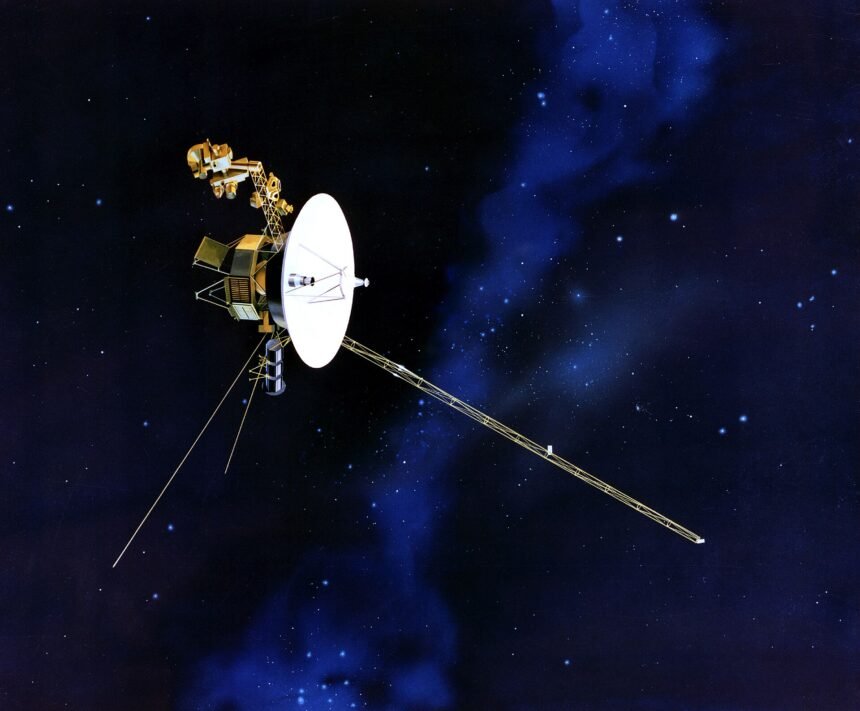
Some time on Wednesday afternoon in India, a spacecraft built in the 1970s will cross a line no human-made object has crossed before. NASA’s Voyager 1 will be one light-day from Earth, meaning a radio signal travelling at the speed of light will need a full 24 hours to reach it.
NASA has put the moment at 10:16:07 UTC on 18 November 2026. That is 3:46 PM in India. The agency notes the exact timing may shift slightly.
How far is one light-day?
Light covers about 25.9 billion kilometres in a day. That is roughly 16.1 billion miles, or a little over 173 times the distance between the Earth and the Sun.
To put it another way, sunlight reaches Earth in about eight minutes. A message from Voyager 1 now needs a whole day to reach home, and any reply from mission controllers needs another day to get back. A single command and confirmation now takes about two days.
EarthSky, citing NASA, reported that in early October the spacecraft was about 25.72 billion km away, with a one-way signal time of 23 hours, 52 minutes and 30 seconds. The gap has kept growing since.
A 49-year journey
Voyager 1 launched on 5 September 1977, a few weeks after its twin, Voyager 2. It flew past Jupiter in 1979 and Saturn in 1980, sending back close-up images that reshaped what scientists knew about both planets and their moons.
After Saturn, the mission’s path took it up and out of the plane of the planets. On 14 February 1990, it turned its camera back towards home and captured the famous “Pale Blue Dot” image, showing Earth as a speck in a sunbeam. It was the last picture Voyager 1 ever took. The cameras were switched off soon after to save power.
In 2012, Voyager 1 crossed the heliopause, the boundary where the Sun’s stream of charged particles gives way to the material between the stars. That made it the first spacecraft to reach interstellar space. Voyager 2 followed in 2018.
Reaching one light-day has taken 49 years, 2 months and 11 days, according to EarthSky’s count.
Still talking, but with less to say
Both Voyagers still send data. But they run on radioisotope power, which produces a little less electricity every year, and engineers have been shutting systems down one at a time to keep the spacecraft alive.
Most of Voyager 1’s science instruments are now off. In April 2026, NASA switched off its Low-Energy Charged Particle instrument, though the team said it could be turned on again in future if power allows. The mission team has also been planning ways to stretch the lifespan of both probes for as long as possible.
Each spacecraft also carries a Golden Record, a gold-plated disc with sounds, music and images from Earth, meant for anyone who might find it. Voyager project scientist Linda Spilker has said that once the probes can no longer talk to Earth, the records become “our silent ambassadors”.
What happens on the day
Nothing will change on the spacecraft itself. There is no manoeuvre, no switch to flip. The milestone is about distance and time, and the fact that a machine launched before most of today’s engineers were born is still out there, still sending a faint signal home.
NASA has invited the public to mark it with a small gesture. Under its “Shine Bright” event, people were asked to flash the letters V-G-R in Morse code towards the sky after sunset on Tuesday, 17 November, using a torch or phone light.
What about Voyager 2?
Voyager 2 is about 2 billion miles closer to Earth than its twin, because it took a different route past Uranus and Neptune. NASA expects it to reach one light-day from Earth in November 2035, if it is still running by then.
Voyager 1, meanwhile, will keep drifting outward. It is not heading towards any particular star. In about 40,000 years, it will pass within roughly 1.7 light-years of a small star known as Gliese 445. By then, it will have been silent for a very long time.
Why it matters
A light-day is still a tiny distance on the scale of the galaxy. The nearest star beyond the Sun is more than four light-years away. Even so, Voyager 1 is the only object humans have sent this far, and it is a reminder of how slowly, and how stubbornly, our machines move through space.
Reporting based on EarthSky, NASA Scientific Visualization Studio, IFLScience and Anadolu Agency.
Featured image: NASA/JPL, via Wikimedia Commons (Public domain)