Imagine planning a ceremony several months in advance when the timing depends on the Moon and on the season. A person could wait to observe the sky each evening, but that would leave the date undecided for much of the year. A written calendar rule lets people coordinate ahead of time. The Vedanga Jyotisha, an early Indian text associated with Vedic ritual, records a system for making those calculations.
The Vedic Heritage Portal describes Jyotisha as one of the Vedangas, disciplines associated with understanding and putting Vedic texts into practice. It connects this particular work with finding the days and hours for sacrifices and notes its traditional association with Lagadha. The portal also notes that scholars continue to disagree about aspects of the text. Reading it as a practical calendar manual makes many of its questions easier to understand before getting into debates about individual verses.
The months and seasons had to stay in step
A year counted through lunar months presents a problem if you also want dates to stay near the same season. The Moon’s recurring phases give a clear marker for a month, while the seasons follow the solar year. Twelve lunar months come up short of that year. If a calendar simply restarts after each set of twelve, its months gradually shift through the seasons. Adding a month at a suitable point within a calendar cycle can bring the two ways of counting closer together.
Take an imaginary ceremony associated with the onset of winter. If the people planning it need a particular lunar phase as well, they have two conditions to track. A rule can tell them where that phase falls in the calendar and which month to count it in. The rule can then be taught to someone else, compared with experience and used again. In a society where people have to travel to a shared event or gather what it requires, being able to plan that far ahead has a practical value.
What a five-year cycle accomplished
M. D. Srinivas, in an overview hosted by IIT Gandhinagar, describes the text as a short manual with rules involving a five-year cycle. It includes calculations for calendrical units such as tithi and nakshatra, alongside the seasons, solstices and length of the day. A cycle compresses a large number of decisions into one repeatable scheme. You can work forward from a starting point instead of creating a calendar from scratch every year.
An average motion is especially useful for this purpose. If a rule treats a motion as uniform, the arithmetic is easier to carry out with limited tables. Real motions can differ from that average, yielding a difference between a calculated result and an observation. An account of Indian calendars published in International Astronomical Union proceedings describes later calendar methods that used true positions of the Sun and Moon. That change helps explain why a familiar idea can survive in a later calendar even when the way it is calculated changes.
How to look at a later almanac
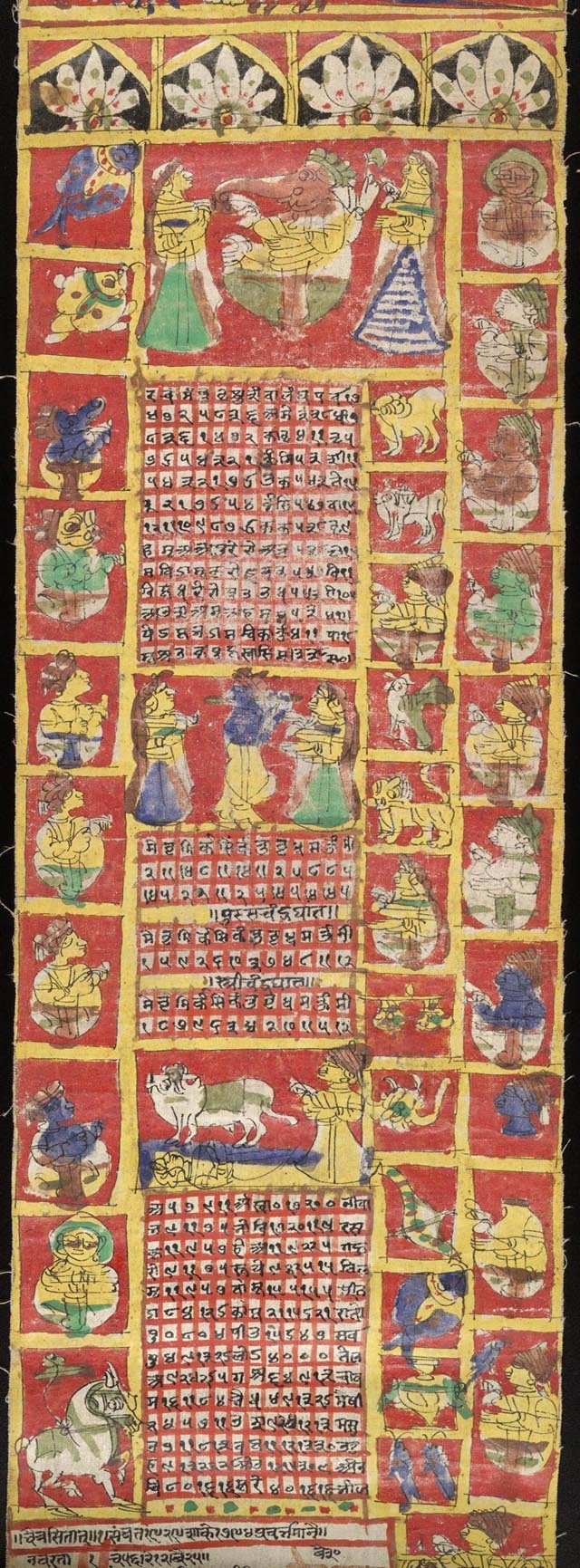
The fabric almanac from Rajasthan shown with this article is catalogued by the Library of Congress and dates to 1871–72. It comes from a much later period. Its panels and zodiac figures give a sense of how a calendar object could hold cultural and religious meaning as well as information about time. Read it as an example of what a later almanac looked like and use the surviving verses and research for questions about the ancient text itself.
The next time you see a tithi printed beside a modern date, pause to ask what each number is measuring. One belongs to a civil calendar with a fixed convention for the day. The other tracks a relation between the Sun and Moon. A printed calendar lets both appear on the same page. The older problem of making several kinds of time intelligible to the same reader still sits behind that familiar format. For a modern example, see The Popular Story’s guide to reading a panchang.
Featured image: Unknown artist / Asian Division, Library of Congress, via Wikimedia Commons. Image source.