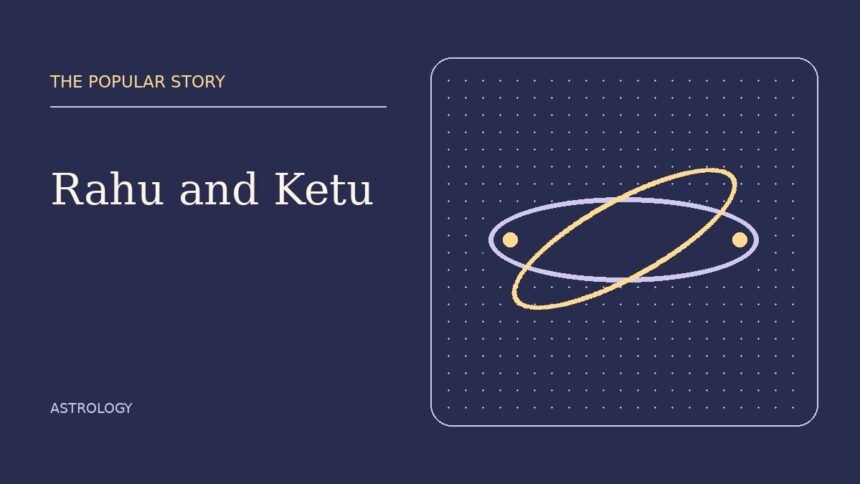
Jyotish charts give two positions the names Rahu and Ketu. The positions are also called the ascending and descending lunar nodes. Readers who first encounter the names alongside the Sun, Moon and planets can recognise them by picturing two crossing paths. The useful fact for a chart is that the two crossings are opposite each other. The useful fact for an eclipse is that the Moon must be close to a crossing when the Sun, Earth and Moon line up closely enough.
A published treatment of the Siddhāntasundara describes the ascending and descending nodes in an Indian astronomical context and identifies Rahu with the ascending node. NASA’s description of the Moon’s tilted orbit provides a modern way to visualise when an eclipse takes place. The accounts are useful for different purposes. The historical material explains the terminology, and the astronomy describes the positions and alignment involved.
Draw two planes in your mind
The plane of Earth’s orbit around the Sun supplies a reference. The Moon’s orbit around Earth is tilted by about five degrees relative to it, according to NASA. Where the two orbital planes intersect, the Moon’s orbital path crosses the reference plane in two places. At one crossing the Moon passes from one side of the plane to the other in the direction called ascending. At the other the direction is reversed, so the node is called descending.
A sketch can help. Imagine a level hoop and another hoop tilted through it. Viewed from the side, the tilted hoop goes above the level one for part of its path and below it for another part. Put a mark at each point where the hoops meet. The illustration leaves out distances and motion, but it makes the idea of two opposite crossings easier to follow.
Why an eclipse needs more than a phase
A solar eclipse occurs at new Moon when the Moon passes in front of the Sun from the relevant location on Earth. A lunar eclipse occurs at full Moon when Earth’s shadow falls on the Moon. The tilt explains why these events do not happen at every new or full Moon. Much of the time the Moon passes far enough above or below the necessary alignment for the shadows to miss.
The Moon’s phase tells you about the relative direction of the Sun and Moon as seen from Earth. The node tells you whether the Moon is close to the reference plane at the relevant time. For someone comparing a chart with an eclipse announcement, it helps to keep both conditions visible. Reading a date from a calendar without checking the alignment can produce an incorrect assumption. Use a current astronomical source for the type, date and visibility of an actual eclipse.
What the chart labels describe
Rahu and Ketu have meanings in Jyotish interpretation and appear in traditional stories connected with eclipses. In the chart their positions refer to the two nodes. A reader may find interpretive descriptions in a traditional source, but those descriptions should be presented as part of astrology. A drawing of the geometry shows how the crossings relate to each other without supplying a prediction about a person’s life.
When you compare two charts, look for the calculation method and exact degree reported for each node. Check whether both charts use the same time and settings before trying to explain a small difference. If the only question is why Rahu and Ketu appear across from each other, the answer is already in the crossing geometry. Both points are on the same line of intersection, on opposite sides.
To follow the subject further, use an astronomy page to understand the tilt and use the historical reference for the terms that appear in Indian texts. Then return to a chart and locate the two names. That sequence gives context to a familiar symbol while keeping the distinction between an orbital calculation and a traditional interpretation clear.
Sources
- https://science.nasa.gov/moon/eclipses/
- https://namami.gov.in/sites/default/files/Prakshika/Prakashika59%20Siddhanta%20Sundara.pdf
Original editorial illustration prepared for The Popular Story.